The Digital Handshake: An Introduction to the Quick Response Code Payment Technology Industry

In the rapidly evolving world of digital finance, one of the most transformative and ubiquitous technologies has been the simple, pixelated square. The global Quick Response Code Payment Technology industry is built around the use of these two-dimensional barcodes, known as QR codes, to initiate and complete financial transactions. This technology has revolutionized payments by creating a fast, contactless, and incredibly low-cost method for transferring money between consumers and merchants. Unlike traditional card payments that require expensive point-of-sale (POS) terminals, a QR code payment can be initiated with nothing more than a smartphone and a printed piece of paper or a screen. The process is elegantly simple: a customer uses their smartphone's camera to scan a QR code displayed by a merchant, which then triggers a payment from the customer's linked bank account or digital wallet to the merchant's account. This simplicity and accessibility have led to explosive adoption, particularly in Asia, and it is now rapidly gaining traction globally, transforming everything from street-side vendor sales to large retail checkouts and peer-to-peer money transfers.
The industry's technology operates on two primary models: merchant-presented QR codes and customer-presented QR codes. The merchant-presented model is the most common. In this scenario, the merchant displays a QR code that the customer scans. This QR code can be either "static" or "dynamic." A static QR code is a fixed code, often printed on a sticker and placed at the checkout counter. It contains the merchant's payment information. When a customer scans it, their payment app opens, and they must manually enter the transaction amount before confirming the payment. This is ideal for small vendors with low transaction volumes. A dynamic QR code, on the other hand, is generated uniquely for each transaction, typically on a POS screen or a dedicated device. This code contains both the merchant's information and the specific transaction amount. When the customer scans it, the amount is pre-filled in their app, and all they need to do is authenticate and confirm. This is faster and less error-prone, making it suitable for larger retailers and high-volume environments.
The second model is the customer-presented QR code, which is often used by larger retailers with more sophisticated POS systems. In this workflow, the roles are reversed. The customer opens their payment app (like Alipay, WeChat Pay, or a bank's mobile app), which generates a unique, temporary QR code on their phone's screen. This QR code contains the customer's payment credentials. The merchant then uses a barcode scanner at their point-of-sale terminal to scan the QR code on the customer's phone. This action pulls the customer's payment information and initiates the transaction, debiting the customer's account and crediting the merchant. This model is generally faster at the checkout, as it requires no action from the customer other than presenting their phone, and it integrates seamlessly with the retailer's existing scanner hardware and inventory management systems. Both the merchant-presented and customer-presented models have their place, and the choice often depends on the merchant's size, transaction volume, and existing technology infrastructure.
The impact of this technology has been profound, particularly in promoting financial inclusion and a cashless society. In many developing economies where credit card penetration is low and the cost of traditional POS terminals is prohibitive for small merchants, QR codes have enabled millions of small businesses to start accepting digital payments for the first time. A street food vendor, a taxi driver, or a small market stall owner can participate in the digital economy with nothing more than a smartphone and a printed QR code. This has dramatically reduced the reliance on cash, which is costly to handle and carries risks of theft and loss. The technology also provides a foundation for a host of other financial services. Once a merchant is accepting digital payments, they build a transaction history, which can then be used by financial institutions to offer them micro-loans or other financial products, further driving economic growth and financial inclusion. QR code payment technology is more than just a convenience; it is a powerful engine for economic empowerment.
Explore More Like This in Our Regional Reports:
South America Banking As A Service Market
Categorii
Citeste mai mult
Environmental management, supported by specialized acoustic Technologies and Devices Names, represents a rapidly growing component of the overall Pet Noise Anxiety Market Size. The Market Trend here focuses on proactively modifying the pet's living space to mitigate the stimulus of anxiety-inducing sounds. The primary Use Cases include sound-masking with...

As Per Market Research Future, the Automotive Off-Highway Engine Industry is rapidly evolving, characterized by technological advancements and expanding applications across multiple sectors. This industry includes a variety of products, such as heavy-duty vehicle engines, construction machinery powertrains, and off-road equipment engine technology. The growing focus on performance, durability,...
Executive Summary Dubai and Saudi Arabia Wood Based Panel Market Size, Share, and Competitive Landscape The Dubai and Saudi Arabia wood-based panel market size was valued at USD 2.37 billion in 2024 and is expected to reach USD 2.96 billion by 2032, at a CAGR of 2.80% during the forecast period. This Dubai and Saudi Arabia Wood Based Panel...
Executive Summary Liquid Analytical Instrument Market Market Opportunities by Size and Share CAGR Value The Liquid Analytical Instrument Market was valued at USD 510 million in 2025 and is projected to reach USD 720 million by 2032, growing at a CAGR of 5% during the forecast period. To achieve detailed market insights and keep market place clearly into the focus, such wide-ranging...
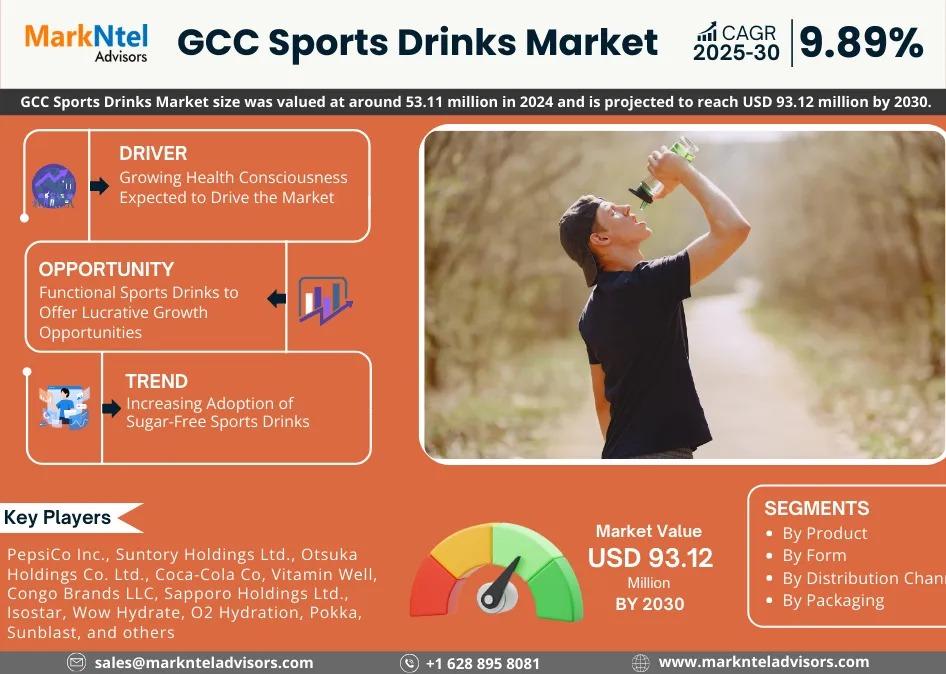
MarkNtel Advisors, a leading market research and consulting firm, has announced the release of its latest study titled GCC Sports Drinks Market Research Report: Forecast (2025-2030). This report provides a detailed assessment of the GCC Sports Drinks Market, covering its evolving dynamics, emerging trends, key growth drivers, major challenges, and competitive landscape. Designed...