How 5G Network Deployment is Driving Point-to-Point Microwave Antenna Market Growth ?
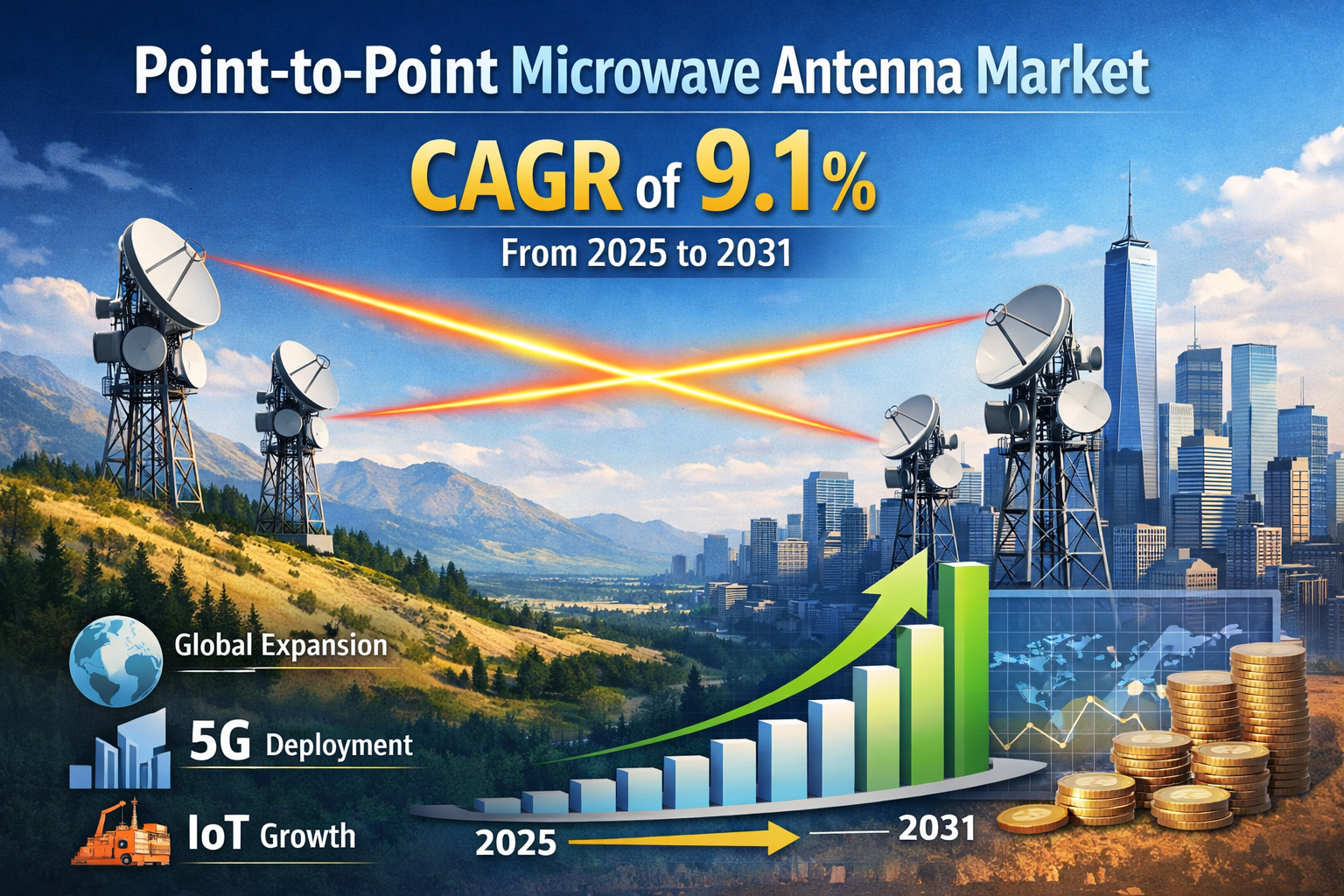
A Point-to-Point Microwave Antenna is a directional wireless communication system used to transmit data between two fixed locations through microwave radio frequencies. It creates a dedicated, high-capacity link that enables the transfer of voice, video, and data without the need for physical cables such as fiber optics. These antennas are commonly deployed in telecommunications networks, enterprise connectivity, broadcasting, defense communications, and smart infrastructure projects.
Market Size ,Share And Trends
According To The Insight Partners , The Point-to-Point Microwave Antenna Market is anticipated to expand at a CAGR of 9.1% throughout the 2025–2031 forecast period, Point-to-point microwave antennas function based on a line-of-sight transmission principle, requiring accurate alignment between the transmitting and receiving units. For optimal performance, the signal path must remain free from significant obstructions such as buildings, vegetation, or uneven terrain. These antennas concentrate radio frequency energy into a tightly focused beam, enhancing signal gain while minimizing interference from nearby communication systems, thereby ensuring stable and efficient data transmission.
Market Overview
The convergence of Software-Defined Networking (SDN) technology with point-to-point microwave antenna systems represents one of the most significant innovations in telecommunications infrastructure management. This integration is fundamentally transforming how network operators deploy, manage, and optimize wireless backhaul networks, shifting from static, manually-configured systems to dynamic, self-optimizing intelligent networks. As the global microwave antenna market evolves toward greater complexity with higher frequencies, denser deployments, and demanding performance requirements, SDN integration has emerged not merely as a competitive advantage but as an operational necessity for modern network management.
Market Drivers for Software-Defined Networking Adoption
1. 5G Network Complexity
5G networks are exponentially more complex than previous generations:
- 10x more cell sites per coverage area
- Dynamic spectrum sharing across bands
- Network slicing creating virtual networks
- Ultra-low latency requirements (1-5ms)
2. Operational Cost Pressures
Telecommunications operators face intense pressure to reduce operational expenses:
- Declining revenue per bit (consumers expect more data for less money)
- Competition from over-the-top (OTT) service providers
- Margin compression requiring efficiency improvements
3. Service Agility Requirements
Modern telecommunications businesses demand rapid service deployment:
- Enterprise customers expect network services provisioned in hours, not weeks
- IoT applications require dynamic bandwidth allocation
- Content delivery networks need rapid topology changes
- Mobile virtual network operators (MVNOs) require flexible capacity
Get A Sample PDF @ https://www.theinsightpartners.com/sample/TIPRE00005273
Point to Point Microwave Antenna Market Opportunities
- Rising Smart City Infrastructure Projects:- The rapid development of smart city initiatives across major urban centers is creating strong growth opportunities for the Point-to-Point Microwave Antenna market. Governments in countries such as India, China, and the United States are investing heavily in digital infrastructure to improve urban mobility, public safety, utilities management, and environmental sustainability.
- Software-Defined Networking Integration : - SDN introduces centralized and programmable control over network infrastructure, enabling operators to dynamically manage traffic flows, bandwidth allocation, and routing paths. When integrated with point-to-point microwave antenna systems, SDN enhances operational flexibility and overall network efficiency. Operators can optimize spectrum utilization, automatically reroute traffic during congestion or outages, and adjust transmission parameters based on environmental conditions such as rain fade or interference.
FAQ
1.Why are PtP microwave antennas important for 5G deployment?
PtP microwave antennas are essential for 5G backhaul because they enable high-speed data transmission between base stations and core networks. They support the massive bandwidth, low latency, and scalability requirements of modern 5G infrastructure.
2.How are private networks contributing to market expansion?
Enterprises are increasingly adopting private networks to improve data security, reduce latency, and enhance operational efficiency. PtP microwave antennas provide a flexible, cost-effective, and quickly deployable solution for connecting geographically distributed facilities.
3.What emerging opportunities exist in this market?
Key opportunities include smart city infrastructure development, where antennas support traffic management, public safety, and IoT systems, as well as Software-Defined Networking (SDN) integration, which enables real-time performance optimization and efficient spectrum utilization.
4.What antenna configurations are available in the market?
The market offers antennas with varying diameters (from 0.2–0.9 meters to 3.0–4.6 meters) and polarization types, including single-polarized and dual-polarized configurations, to meet diverse network needs
Market Segmentation
By Frequency Range
- 3.6 GHz to 9.9 GHz
- 10.0 GHz to 29.9
- 30.0 GHz to 86.0 GHz
By Diameter
- 0.2 m to 0.9 m
- 1.0 m to 3.0 m
- 3.0 m to 4.6 m
By Polarization
- Single Polarized Antenna
- Dual Polarized Antenna
Regional Landscape
The market spans across North America, Europe, Asia-Pacific, South and Central America, and the Middle East and Africa. Each region presents unique growth dynamics influenced by local telecommunications infrastructure development, regulatory frameworks, and technological adoption rates.
Top Key Player
- CableFree
- CommScope Holding
- Infinite Electronics
- Kavveri Telecoms
- LEAX Arkivator Telecom AB
- mWave Industries, LLC
- Radio Frequency Systems
- Rosenberger
- TESSCO
Future Outlook
Technological advancements continue to push the boundaries of what's possible with point-to-point microwave antennas. Higher frequency bands such as E-band and V-band are enabling unprecedented data transmission speeds, with some modern systems supporting multi-gigabit capacities over long distances. Advanced modulation techniques and adaptive coding are improving spectral efficiency, allowing more data transmission within limited frequency spectrums.
About The Insight Partners
The Insight Partners delivers market intelligence and consulting services to help clients make informed decisions. The firm covers industries such as Aerospace and Defense, Automotive and Transportation, Semiconductor and Electronics, Biotechnology, Healthcare IT, Manufacturing, Medical Devices, Technology, Media, and Chemicals and Materials.
Contact Information:
Email: sales@theinsightpartners.com
Website: www.theinsightpartners.com
Phone: +1-646-491-9876
Also Available in :
Categories
Read More
Introduction The Water Utility Monitoring System Market is expanding rapidly as global water networks face increasing pressure from rising urban populations, aging infrastructure, climate change, and heightened demand for clean, reliable water supply. Water utility monitoring systems play a critical role in ensuring efficient distribution, leakage detection, real-time quality assessment, and...

The global graphene solar cell market is advancing rapidly as industries seek next-generation photovoltaic technologies that offer superior efficiency, flexibility, and durability. The Graphene Solar Cell Market Trends highlight breakthroughs in materials science, energy conversion, and large-scale manufacturing. As Per Market Research Future, this emerging technology is gaining traction due to...

Global Soil Treatment Market size and share is currently valued at USD 46.77 billion in 2024 and is anticipated to generate an estimated revenue of USD 81.34 billion by 2034, according to the latest study by Polaris Market Research. Besides, the report notes that the market exhibits a robust 5.7% Compound Annual Growth Rate (CAGR) over the forecasted timeframe, 2025 - 2034 The global...

Global Sports Graphics Market Size, Share, and Trends Analysis Report – Industry Overview and Forecast to 2032 The Global Sports Graphics Market size was valued at USD 2.98 billion in 2024 and is expected to reach USD 5.00 billion by 2032, at a CAGR of 6.70% during the forecast period ...
Executive Summary Curative Therapies Market Market Size and Share Analysis Report CAGR Value Global curative therapies market is expected to gain market growth in the forecast period of 2021 to 2028. Data Bridge Market Research analyses the market to account to grow at a CAGR of 8.00% in the above mentioned forecast period. With the use of few steps or the combination of several...